2027 Is Already Locked In
Executive Summary
Funding against the coordinated humanitarian appeals roughly halved in a single year, from US$22.6 billion in 2024 to about US$12 billion in 2025, the lowest in a decade. The 2025 cut of more than US$8 billion was the largest ever recorded, the sector is about 30% smaller than in 2023, and 2026 shows no return to 2024 levels: as of 1 August the appeals stand 38.1% funded, US$13.3 billion against US$34.9 billion in requirements.
The inputs for the 2027 harvest are being priced right now. Urea spiked about 50% in the war's first weeks before falling back, DAP climbed from around US$669 to roughly US$932 a tonne between January and May, and sulphur has more than doubled since February. FAO's own chief economist says the Hormuz closure removes between a quarter and a third of key agrifood inputs. Planting decisions across the Southern Hemisphere land in the next 90 days.
The climate of 2027 has already been bought. Atmospheric CO2 will average around 429 ppm this year, rising too fast to track any 1.5°C pathway, and the WMO's own lead forecaster has named 2027 as the likely next record-breaking year because of the El Niño now developing.
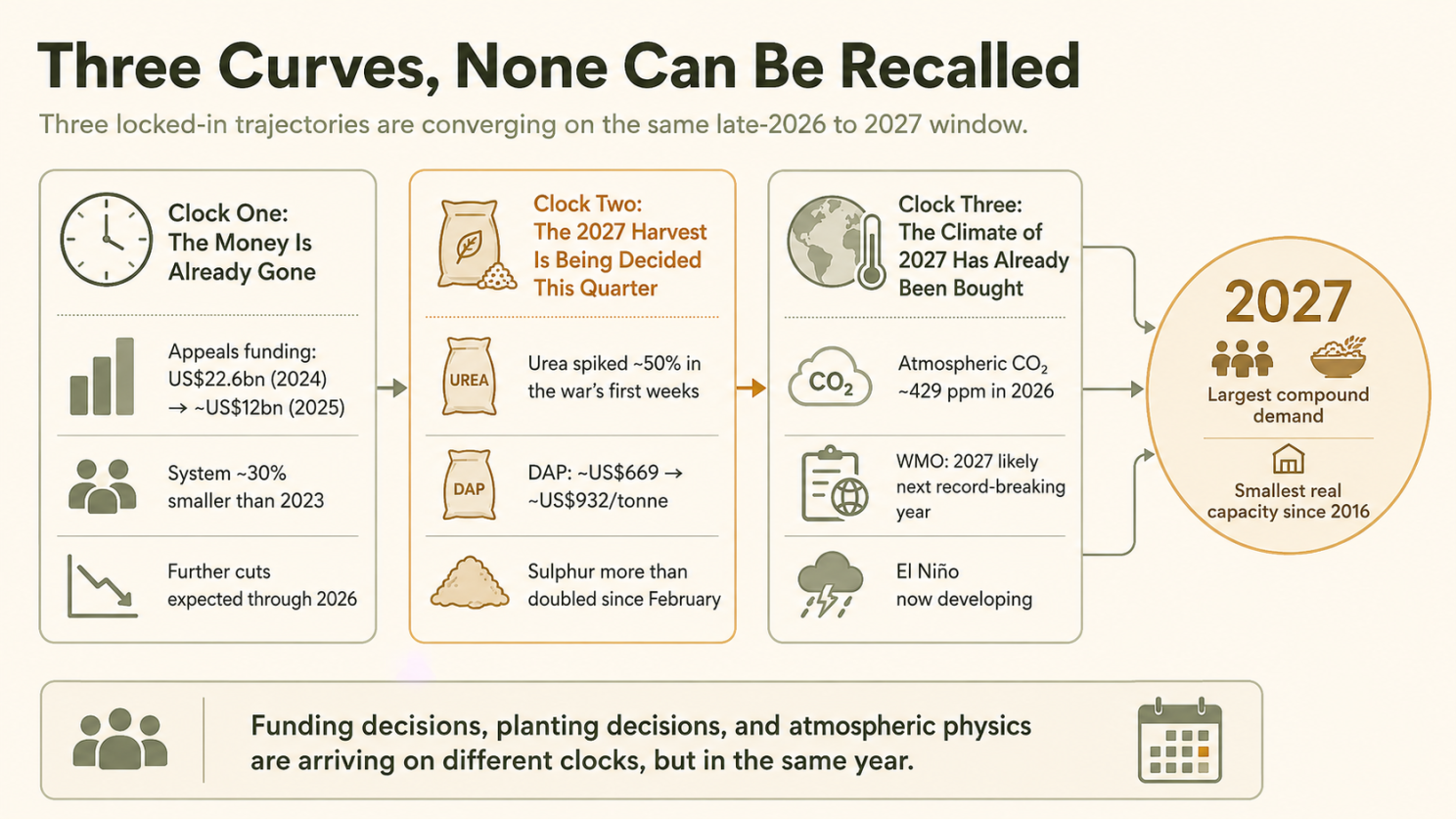
Three curves, none of which can be recalled, cross in the same 18 months. The response system will meet its largest compound demand with its smallest real capacity since 2016.
The week we all watched
I have spent the past month with my eyes where everyone else's are. The tanker fires. The US$100 oil settlement on 23 July. The insurance circulars redrawing the map of the Gulf. It is riveting, and it is also a trap.
Because the story that matters is not what is happening. It is what has already happened, and cannot now be taken back. This morning I published a 27-page working paper on the food-security transmission of this war, and the hardest section to write was not the one about missiles. It was the one titled "what is already locked in, and what is not." This post is about three things that are locked in. Full paper here: https://www.researchgate.net/publication/411033777
Understand, I am not saying the now does not matter. Brent moved US$16.60 in six trading sessions, from US$94.07 on 22 July through US$100.69 on 23 July to US$84.09 five days later. Lloyd's market bodies have logged more than 45 attacks on commercial shipping. On 29 July the Joint War Committee listed Saudi Arabia in full and pushed the Red Sea war-risk boundary north to 25.5°N. The insurers, as ever, are the war's most honest cartographers.
And the UN's climate chief connected it to your food bill better than most market analysts did. Conflict, Simon Stiell told the General Assembly on 24 July, has "choked global energy markets, pushing up prices for billions of people."
But a price that moves US$16.60 in six sessions is a market pricing headlines, not outcomes. The outcomes are being set elsewhere, on three slower clocks. Here they are.
Clock one: the money is already gone
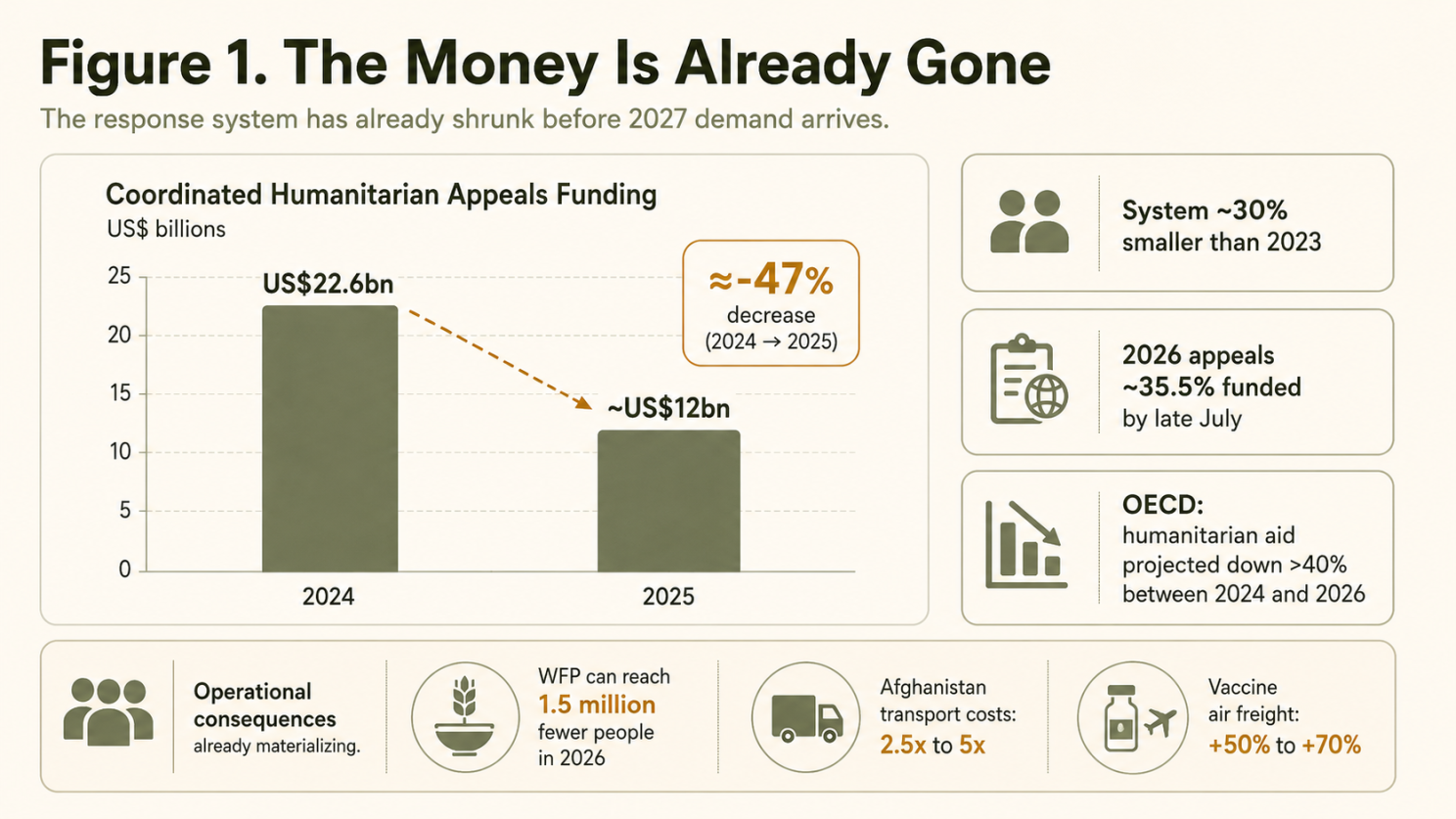
Let's be honest about the sequencing. The funding collapse did not start with this war. I've tracked it since the first USAID termination letters went out, and the record is now official: 2024 brought cuts of nearly US$6 billion, then 2025 delivered the largest decline ever recorded, more than US$8 billion, driven by the closure of USAID. The Global Humanitarian Assistance report puts the system at around 30% smaller than 2023, with further cuts anticipated this year.
Against the appeals, the numbers are stark. The coordinated plans took in US$22.6 billion in 2024. In 2025 they received about US$12 billion, the lowest in a decade by the UN relief chief's own account. Which is why the 2026 ask of US$23 billion for the hyper-prioritised plans, roughly double what was actually available last year, is being sold as realism. Do the math on that sentence. The UN is asking for twice last year's money and calling it a stretch goal. As of 1 August, the 2026 appeals stand 38.1% funded, US$13.3 billion against US$34.9 billion in requirements. The US has provided US$6.3 billion by 1 August against US$14.1 billion in all of 2024. The UK has gone from US$2.3 billion in 2024 to about US$894 million so far this year. OECD projections now put humanitarian aid down more than 40% between 2024 and 2026.
From budgets to ration cards
Those are budget lines. Here is what they look like on the ground, from the operational evidence in the paper. WFP expects to serve 1.5 million fewer people than planned in 2026, with more than nine million at risk of losing assistance if the disruption persists. Its external transport costs into Afghanistan have risen 2.5 to 5 times, with delivery times stretching from about 10 days to as many as 75. Air freight for vaccines from India to Ethiopia, Nigeria and the DRC is up 50% to 70%. Sea freight from China to Yemen and Mozambique has doubled or more. Every one of those numbers is a ration card, a cold-chain box, a truck that does not leave.
The last growth donors are under fire
And the one growth segment of the last decade, the Gulf donors who ranked fourth and fifth in 2025, have already slipped down this year's donor table and just watched their own coastlines become listed war-risk areas. Budget decisions for 2027 are being written in capitals that are themselves under fire.
This is the first locked-in trajectory. Whatever 2027 demands, the money answering it has already been decided by parliaments and presidents in 2025 and 2026. Pipelines take months to fill. They are being emptied instead.
Clock two: the 2027 harvest is being decided this quarter
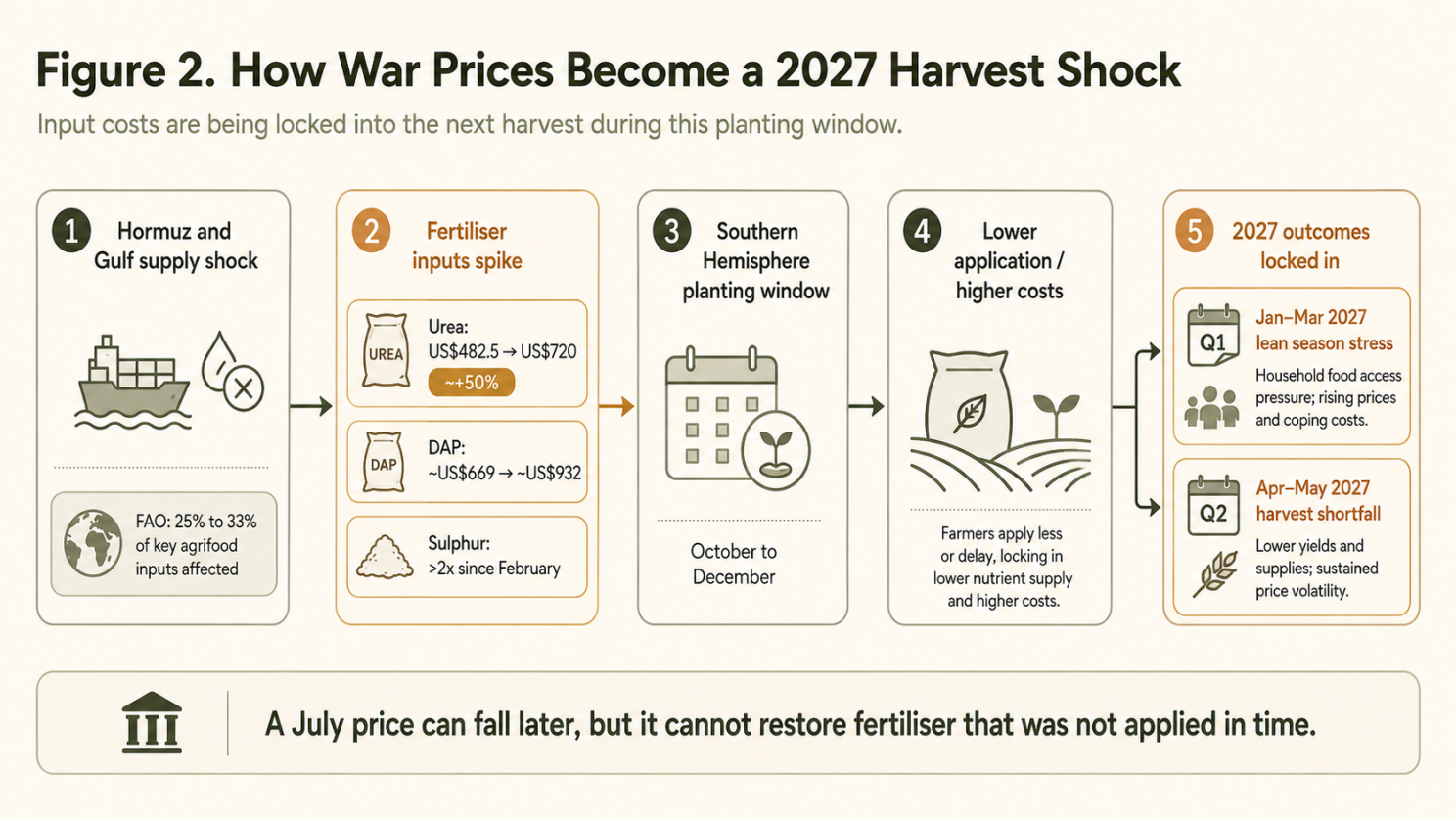
Here's the mechanism most coverage misses. Wars do not cut harvests by burning fields. They cut harvests by repricing inputs during planting windows, and the planting windows are now.
The evidence is in the paper, so I will keep to the spine of it. Urea jumped from US$482.50 to US$720 a tonne in the opening weeks of the war. Qatar's QAFCO, which supplies around 14% of traded urea, has been under force majeure since March. Urea has since fallen back sharply, down 47% from its April peak by June. Phosphate and sulphur have not followed, and a July price cannot restore nitrogen that was not applied in May. DAP went from about US$669 a tonne in January to roughly US$932 by May. Sulphur, the input nobody watches, has more than doubled since late February because the Gulf is the world's largest exporter and sulphuric acid is how phosphate rock becomes fertiliser. There is no substitute.
Don't take my word for the scale. Ten days before publishing SOFI 2026, FAO's Chief Economist Máximo Torero told journalists in New York that the Strait of Hormuz closure removes between a quarter and a third of the key inputs for the world's agrifood systems, and he named them: natural gas, and sulphur for sulphuric acid. The UN's own food economists are describing the same chain this paper maps, in the same words.
A calendar, not a commodity chart
Now put those prices against a calendar. Southern Africa plants October to December. A farmer in Zambia deciding this quarter whether to apply full fertiliser rates is making a 2027 food-security decision with 2026 war prices. Reduced application will not show up anywhere at planting. It shows up at the April-May 2027 harvest, with the regional lean season of January to March 2027 in between, and the forecasters expect El Niño conditions over exactly that season. The 2023-24 event cut South Africa's maize harvest by 22% and pushed Zambia, Zimbabwe and Malawi into drought emergencies. That was with cheap fertiliser.
USDA's own balance sheet already shows world grain consumption exceeding production by 35.5 million tonnes in 2026/27. Madagascar has already published its projection: 3.72 million people in crisis-level food insecurity between October 2026 and February 2027. Not a scenario. A published IPC analysis, sitting in plain sight.
Policy is the accelerant
And hovering over all of it, the fastest amplifier in the system. India supplies around 40% of traded rice. The 2023 export ban was triggered by monsoon damage and a 3% monthly rise in domestic retail prices. Rice sowing is behind this year, El Niño is strengthening into the winter crop, and the benchmark Thai price just hit a one-year high. The trigger conditions are reassembling while the buffer looks largest.
Policy is already diverting food the other way too. Indonesia's B50 mandate took effect on 1 July, raising the palm-oil share of national diesel to half, and its officials framed the acceleration explicitly as insulation against Iran-war supply risk. The world's most traded cooking oil is being converted into transport fuel, by decree, in the same year El Niño threatens palm yields. That decision is in force. It is not a forecast either.
Clock three: the weather of 2027 has already been bought
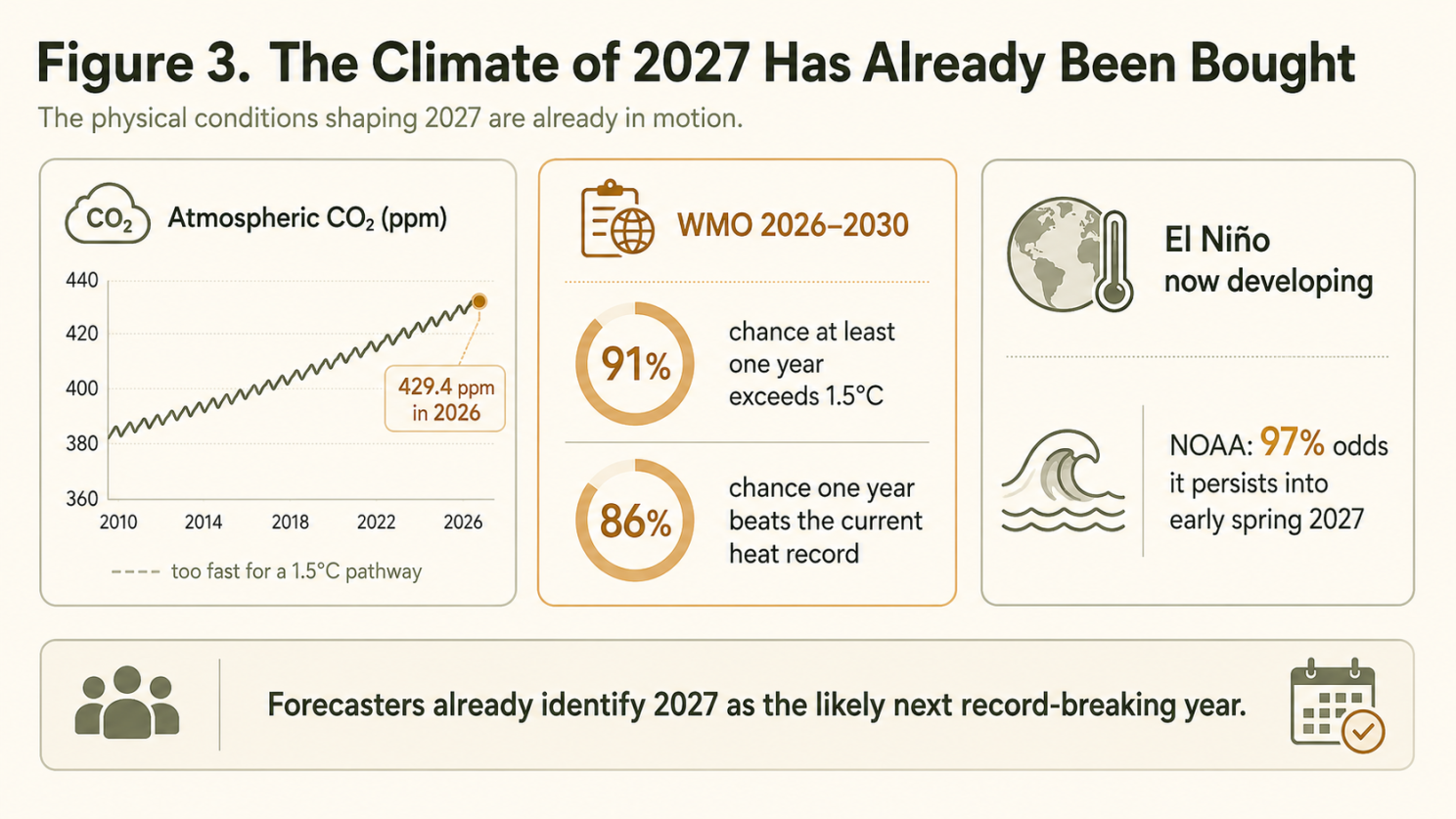
The third clock is the one we pretend is still negotiable. It is not, on any timescale that matters for 2027.
Atmospheric CO2 will average around 429.4 ppm this year on the Met Office forecast, and the rise remains too fast to track any scenario that limits warming to 1.5°C. The WMO's decadal update, published in May, puts every year from 2026 to 2030 between 1.3°C and 1.9°C above pre-industrial, with a 91% chance that at least one of those years crosses 1.5°C and an 86% chance that one beats 2024 as the hottest ever recorded.
The forecasters have named the year
Then the lead author of that update, Leon Hermanson, said the quiet part. An El Niño was predicted for the end of 2026, which "increases the chances of the following year, 2027, being the next record-breaking year." The forecasting system has already put a name on it. NOAA now gives 97% odds the event persists into early spring 2027.
Read that alongside the first two clocks. The same El Niño that threatens the Southern African planting season also loads the dice for record global heat, more intense disaster response demand, and additional stress on the same food systems, in the same year, funded by the same collapsed budgets. FAO and WFP launched an anticipatory-action appeal for exactly this. It sits inside the same 38.1%-funded envelope as everything else.
Where the three curves cross
What a ceasefire cannot buy back
I want to be careful here, because the paper I published this morning spends 27 pages separating what is locked in from what is merely possible, and that discipline matters. A ceasefire tomorrow would change the oil price. It would not refill the aid pipelines emptied in 2025. It would not un-price the fertiliser already skipped this planting season. It would not remove a molecule of carbon from the atmosphere.
That is the honest definition of locked in. Three trajectories, each set in motion by decisions already taken, each arriving on its own schedule, all converging on the same 18-month window from late 2026 through 2027.
Watching it happen in high definition
The response architecture built after 2008 will see it coming with remarkable precision. The G20's own market monitor is already modelling the Hormuz shock pushing food prices materially higher into 2027. Information is not the gap this time. Money is, and time is.
Even I underestimated how tightly the timelines would interlock until I mapped them against each other. In twenty years of field work I have watched this pattern before, a crisis fully visible in the data a year before it arrived, while the system argued about the present.
What to do with the time that is left
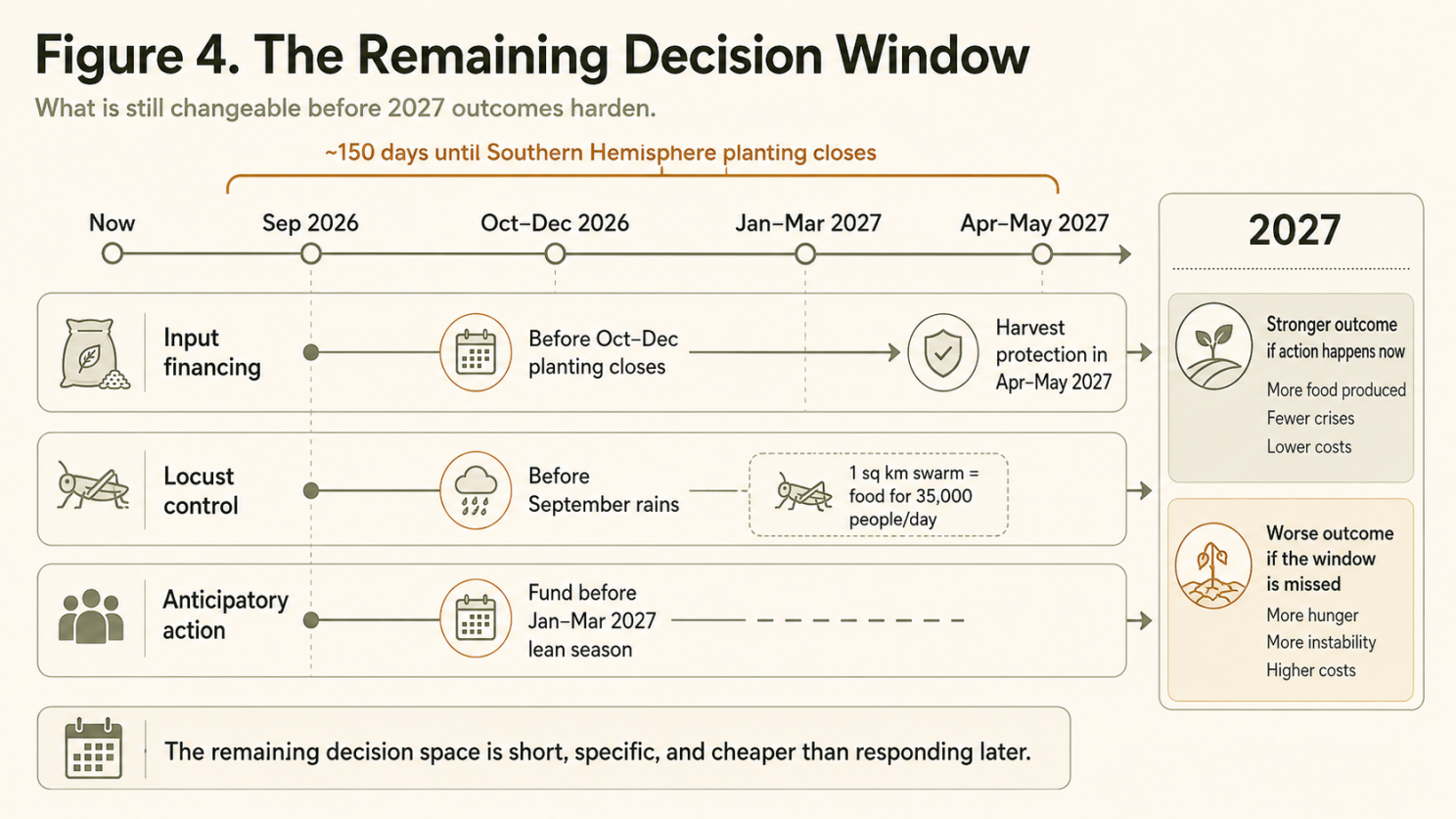
The windows are short, specific, and cheaper than anything that comes after. You get the idea from the paper's decision calendar, but three matter most:
Input financing before Southern Hemisphere planting closes in December. Every dollar into fertiliser access this quarter buys harvest in April 2027 at a fraction of the cost of food aid in mid-2027.
Locust control before the September rains. FAO reports treated area in northwest Africa doubled in June, and its forecast links the coming positive Indian Ocean Dipole to rising outbreak risk across northern and eastern Africa from September. The 2019-22 upsurge taught the arithmetic: a one square kilometre swarm eats what 35,000 people eat in a day.
Anticipatory action ahead of the January-March 2027 lean season, funded now, while it is still anticipatory.
None of this requires new analysis. It requires acting on analysis that already exists, with money that mostly does not. Which is the real subject of this post.
The conclusion I would rather not write
The emergency of 2027 is not a forecast. Large parts of it are a recording, already made, waiting for playback. The funding floor was set by budget decisions in 2025 and 2026. The input costs are being locked into the ground this quarter. The atmospheric physics were settled decades ago and the El Niño is already in the water.
What is not locked in is what we do with the roughly 150 days between now and the close of the Southern Hemisphere planting window. That is the entire remaining decision space, and it is shrinking as I write this.
At the SOFI launch on 21 July, FAO's Director-General insisted that "hunger is not inevitable," that the curve can be bent with policy, protection and investment. He is right. But bending curves takes money and time, and we are spending the first and losing the second while we stare at the explosions.
Enough. The clocks are behind us.
For discussion
If your organisation is planning 2027 programming on 2026 funding assumptions, what would it take to re-plan against a 30% smaller system, this quarter rather than next year?
Country teams in Southern Africa: what are you seeing in fertiliser availability and pricing ahead of the October planting window? Share what you're seeing.
Anticipatory-action advocates have the strongest cost-benefit case in the sector and still sit inside a 38.1%-funded envelope. What actually unlocks pre-positioned money, and who has seen it done?
Which of the three clocks does your organisation's risk register actually track?
Full analysis: The Next Global Food Shock Has Not Arrived Yet (MarketImpact Working Paper WP-2026-04, version 3.0), free on ResearchGate:https://www.researchgate.net/publication/411033777
Quotes from UN officials are remarks as delivered, from UN Web TV recordings of the 24 July General Assembly dialogue, the 15 July FAO press conference and the 21 July SOFI launch.
AI disclosure: AI tools (Claude, Anthropic) supported source verification, data extraction and drafting for this post, including retrieval of UN meeting records. I reviewed and verified every figure and quote against the cited sources and the analysis and conclusions are mine. Details:marketimpact.org/how-we-use-ai
#HumanitarianAid #FoodSecurity #ElNino #ClimateChange #AidFunding #Iran #StraitOfHormuz #AnticipatoryAction #FoodCrisis #HumanitarianFinancing #GlobalHunger #2027
Enjoyed this article?
This post is from Aid and Dev Dispatches, a LinkedIn newsletter with expert analysis on humanitarian reform, AI adoption, crisis economics, and the politics of aid. Join 9,000+ subscribers.